

As an artist duo, we explore connectedness, intimacy, and things that quicken the heart in the lives of others and ourselves. We seek to facilitate the self-narration of their subjects, always encountered on the basis of a great intimacy, rather than constructing their stories for them. This approach enhances the performative quality of filmmaking as a collective process.
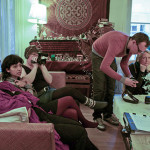
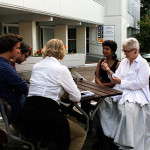
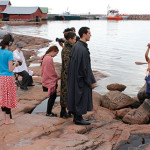

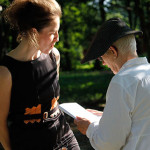
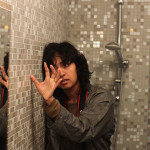
For many years, our chief body of work centred around people in migratory situations, their political struggles, affective separations from family, friends and homeland as well as their identities in transformation. This range of documentaries includes a questioning of rigid conceptions of identity (Becoming Vera). For these works, see http://www.miekebal.org/artworks/films/.
Having made several documentaries in this vein, we embarked on a new type of project in 2009: a theoretical fiction, to be precise. Using this Freudian term, we attempted to develop a new genre in writing and filmmaking that develops and articulates theoretical ideas through fiction, a laboratory where new ideas can be invented and tested. In our larger project Mère Folle, which includes the feature film A Long History of Madness (2011), this genre concept was used as a means of re-presenting real case studies of individuals diagnosed with various forms of madness. In the current exhibition, Saying It, we present one of those cases.1
In spite of their formal differences, fiction and documentary cannot be easily disentangled. Exhibiting our fiction project at the Freud Museum – a historical, hence, to a certain extent, ‘non-fictional’ museum – testifies to the precariousness of this distinction. As artists, we wanted to make an (audio-visual) statement that highlighted the need to readdress these traditional categories. Here we examine and undermine the most tenacious among them by attempting to express something that is by definition inexpressible: the pain of others.
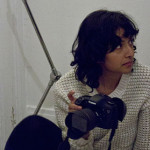
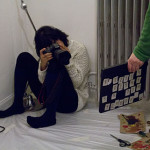
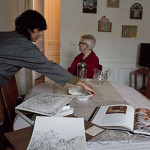
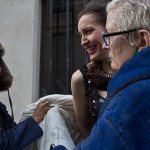
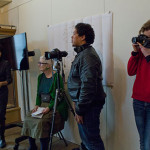
MIEKE BAL (Heemstede, 1946), a cultural theorist and critic, has been Royal Netherlands Academy of Arts and Sciences Professor. She is the author of over thirty books. As a video artist, she makes experimental documentaries on migration and recently has begun exploring fiction. The project A Long History of Madness, with Michelle Williams Gamaker, has yielded a 120’ feature film and a series of video installation pieces. These have been exhibited nine times in one year, among other places in the Aboa Vetus – Ars Nova Museum in Turku, and in the Freud Museum London. Occasionally she acts as an independent curator.
www.miekebal.org
MICHELLE WILLIAMS GAMAKER (UK, 1979) is a video and performance artist. Her work varies from single frame portraits to more complex renderings of reality via documentary, fiction films and video installations. The subtle and sublime potential of storytelling through the everyday is at the root of her work. She has exhibited internationally since 2001; her documentaries include Elizabitch (2004), All About Évike (2005), Colony (2006) and Becoming Vera (2007). In addition to her latest feature film Madame B (2013) with long-term collaborator Mieke Bal, she is working on a series of performance-based videos exploring connections between animals and architecture. Williams Gamaker completed her Ph.D in Fine Art at Goldsmiths College. She currently works at de Gerrit Rietveld Academie as a Fine Art studio tutor, Amsterdam. She lives and works between London and Amsterdam.
www.michellewilliamsgamaker.com